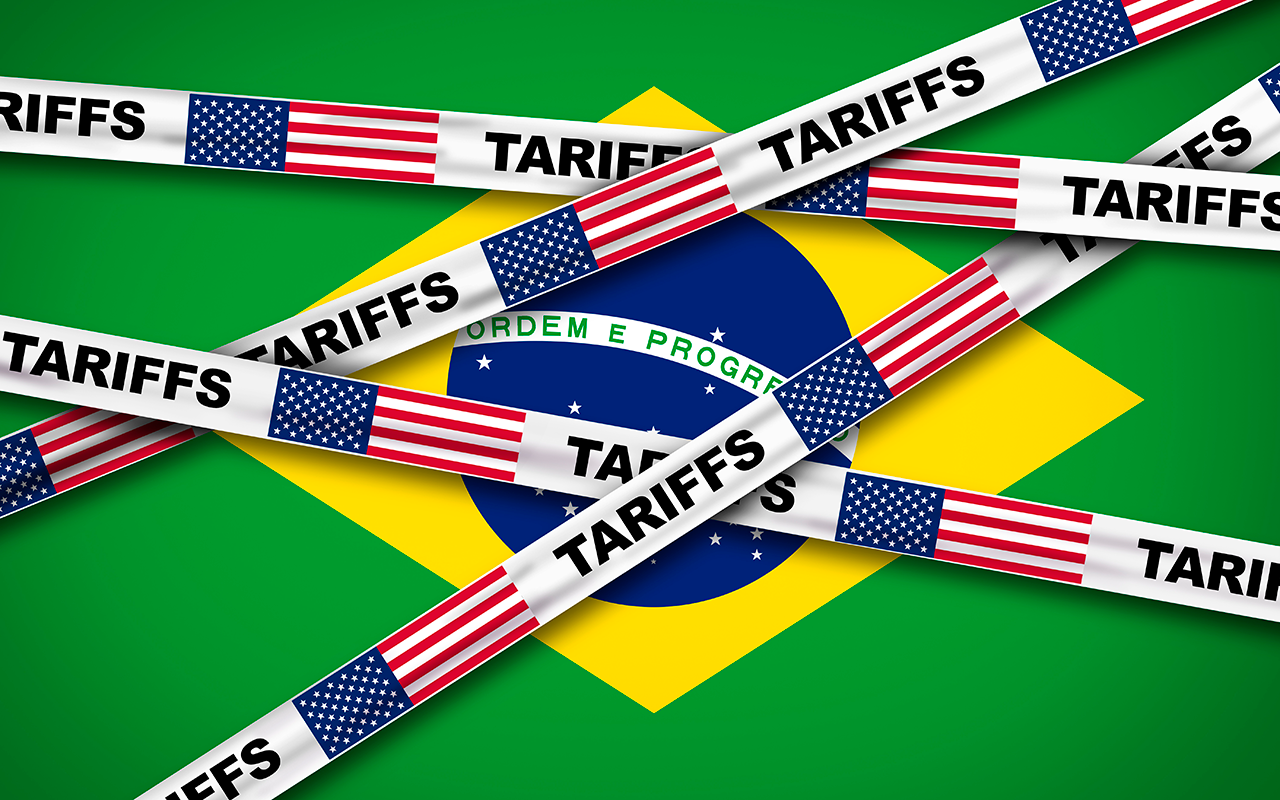
The Office of the United States Trade Representative (USTR) confirmed on 07/15/2026 the application of an additional 25% tariff on a wide range of Brazilian products. The measure, based on Section 301 of the U.S. Trade Act, takes effect on 07/22/2026 and results from an investigation opened in July 2025 into Brazilian practices deemed harmful to U.S. commercial interests.
The published list provides for relevant exceptions for more than 2.000 products with exemption or reduction, such as beef, coffee, oranges and juices, crude oil, natural gas, pharmaceuticals and civil aircraft. On the other hand, items such as ethanol, sugar, agricultural machinery and equipment, footwear, apparel, paper, wood, semi-finished iron and steel products and various chemicals are subject to the surcharge.
The tariff does not reach goods that have already left Brazil before the measure takes effect, and the U.S. government has signaled that the list may be revised as negotiations progress.
Direct effects on exporting companies
Companies in the affected sectors (agribusiness, sugar-energy, metallurgy, machinery and equipment, footwear, textiles, pulp and paper, and chemicals) will see their competitiveness impaired in the U.S. market, with pressure on margins, risk of order cancellation or renegotiation, and possible diversion of demand to competitors from other countries. In addition, companies with ongoing supply contracts must urgently assess the allocation of the tariff cost, the shipment schedule and foreign exchange exposure, since the instability tends to pressure the dollar and raise the cost of imported inputs and foreign-currency debt.
Scale of the impact on the Brazilian economy
According to the National Confederation of Industry (CNI), the surcharge may reach around 4,100 products, corresponding to approximately US$ 14.9 billion in exports. The effects, however, are already being felt: in the first half of 2026, Brazilian exports to the United States fell 13% (about US$ 2.6 billion), with declines in 20 of the 27 states.
There is also a risk of aggravation: should the parallel investigation into forced labor advance, proposing an additional 12.5% surcharge, certain products could face cumulative taxation of up to 37.5%.
Alternatives for tariffed companies
Against this backdrop, affected companies have a set of mitigation measures available, among which we highlight:
- Exclusion requests and participation in USTR procedures: the product list may be revised, which opens room for technical action, individually or by sector, aimed at including items in the list of exceptions;
- Contract review: renegotiation of prices and deadlines, analysis of tariff cost-sharing clauses, force majeure and early shipments where feasible;
- Market diversification: redirecting exports to other destinations and negotiate to expand to new markets, leveraging Mercosur trade agreements and ongoing negotiations with other blocs;
- Special customs regimes and tax planning: use of instruments such as drawback and review of the structure of foreign trade operations to reduce costs of the supply chain;
- Pricing structure reassessment:Customs Valuation and Transfer Pricing considerations should be considered in transactions involving multinational companies and intercompany operations between related entities;
- Government support measures: access to credit lines and other instruments of the Plano Brasil Soberano, maintained by the federal government to protect affected sectors and preserve jobs and productive capacity; and
- Participation in Camex public consultations: private sector input in the domestic procedures for defining any countermeasures, so as to prevent the Brazilian response from burdening inputs essential to national companies themselves.
The Brazilian government’s response and the Reciprocity Law
In a statement released in the early hours of this Thursday (07/16), the Brazilian government announced that it will immediately activate the instruments of the Economic Reciprocity Law (Law No. 15,122/2025), in addition to resorting to the dispute settlement mechanism of the World Trade Organization (WTO).
The Reciprocity Law, regulated by Decree No. 12,551/2025, authorizes Brazil to adopt proportional countermeasures against countries that impose unilateral barriers harmful to national competitiveness. Possible responses include imposing surcharges on imports of U.S. goods and services, suspending concessions or obligations under trade agreements, and suspending intellectual property rights, such as patents and royalty remittances, applicable separately or cumulatively.
Its application follows a specific procedure: the request is submitted to the Interministerial Committee on Economic and Commercial Negotiation and Countermeasures, which may approve provisional countermeasures, of an exceptional nature and under an expedited procedure, or forward the ordinary proceeding within the Foreign Trade Chamber (Camex). Under the ordinary procedure, technical opinions are prepared, the private sector may be heard, a public consultation of up to 30 days is held, and the final decision is taken by Camex’s Strategic Council.
The scenario remains dynamic, with room for negotiation, and it is advisable that potentially affected companies map their exposure from now on and adopt mitigation measures.
Martinelli Advogados remains available to assist in assessing the impacts of the measure and in structuring the appropriate legal and negotiation strategies.