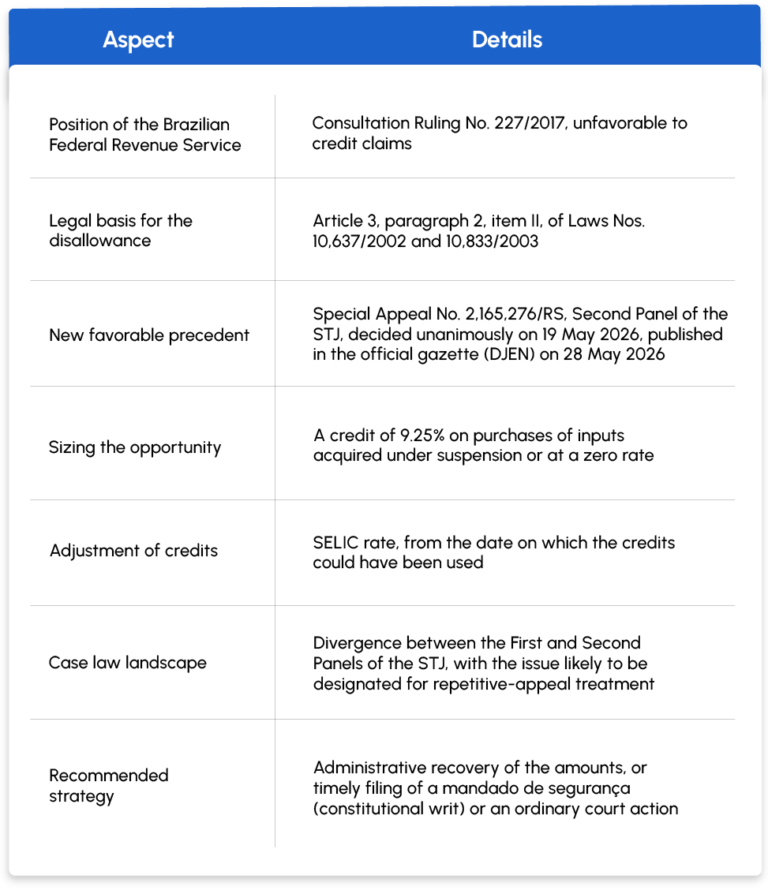
In May, the Second Panel of the Superior Court of Justice (STJ), ruling on Special Appeal No. 2,165,276/RS, unanimously recognized the right to claim PIS and Cofins credits on inputs acquired under tax relief when the final product is taxed on sale. The case concerned soybeans bought under the suspension regime (Article 29 of Law No. 12,865/2013) and used to produce taxed biodiesel.
The ruling departs from the position adopted by the Brazilian Federal Revenue Service in Consultation Ruling No. 227/2017, which disallows such credits under Article 3, paragraph 2, item II, of Laws Nos. 10,637/2002 and 10,833/2003. The decision also reopens the debate over whether the same reasoning extends to zero-rated purchases and purchases made under suspension.
The precedent therefore introduces a taxpayer-favorable reading of purchases under tax relief, against the disallowance maintained by the Brazilian Federal Revenue Service. The court’s reasoning also encompasses zero-rated purchases, significantly broadening the ruling’s practical reach for companies that use such inputs to produce goods whose sale is taxed.
Key Aspects
The STJ Precedent
The court held that, under the non-cumulative regime, PIS and Cofins credits are calculated by applying the rate to the acquisition cost of the input. The statutory disallowance was therefore interpreted a contrario sensu: the exception allowing credits for exempt inputs used to produce taxable outputs shows that the disallowance reaches only goods whose final product is also relieved of tax.
The court also recognized the functional equivalence between indefinite suspension and exemption, reasoning that extending the disallowance to situations not expressly provided for by law contravenes Article 111, item I, of the Brazilian Tax Code (CTN). It ultimately affirmed the taxpayer’s right to calculate and offset the credits, adjusted by the SELIC rate.
Case Law Landscape and Recommendations
Finally, it is worth noting that the issue remains unsettled within the STJ itself. The First Panel has ruled against credits on zero-rated purchases (Special Appeal No. 1,423,000/PR), while the Second Panel has adopted a favorable position on both zero-rated purchases and purchases made under suspension (Special Appeal No. 2,134,586/RS). There are also unfavorable decisions from the Federal Regional Courts for the Third and Fourth Regions (TRF3 and TRF4), and the issue appears likely to be designated for repetitive-appeal treatment.
In light of this, each taxpayer’s actual circumstances should be assessed to determine the most appropriate strategy, whether through administrative recovery or court proceedings. It should also be noted that many cases involving suspension, and some involving zero rates, allow taxpayers to claim presumed credits. Any assessment of the opportunity should therefore take into account amounts already claimed on that basis, so that different scenarios can be presented and the related risks measured.
Glossary
PIS/Cofins: Brazilian federal social contributions generally levied on business revenue, with credits available under the non-cumulative regime subject to statutory requirements.
non-cumulative regime: A tax regime under which taxpayers may calculate credits on certain purchases to offset amounts due on taxable transactions.
tax relief: A general term used in this article for tax treatments that reduce or suspend taxation, including zero-rating, suspension and exemption where applicable.
suspension: A tax treatment under which the collection of a tax or contribution is suspended subject to the applicable statutory rules.
zero rate: A tax treatment under which a transaction remains within the scope of a tax or contribution but is subject to a 0% rate.
exemption: A statutory relief that releases a transaction, taxpayer or other taxable event from a tax or contribution that would otherwise apply.
presumed credit: A tax credit granted by law and calculated according to statutory criteria rather than arising directly from tax charged on a prior transaction.
SELIC rate: Brazil’s benchmark interest rate, also used for statutory interest and adjustment of certain federal tax amounts.
mandado de segurança: A Brazilian constitutional writ used to protect a clear legal right against an unlawful act or abuse of power by a public authority.
repetitive appeals procedure: A Brazilian appellate procedure for selecting representative cases to establish precedent on recurring questions of law.